The Pew Research Center
March 15, 2006
Summary of Findings
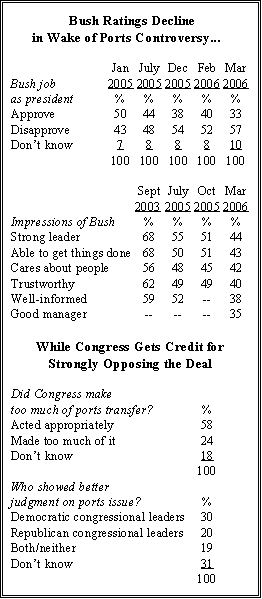 In the aftermath of the Dubai ports
deal, President Bush's approval rating has hit a new low and his image for
honesty and effectiveness has been damaged. Yet the public uncharacteristically
has good things to say about the role that Congress played in this high-profile
Washington controversy.
In the aftermath of the Dubai ports
deal, President Bush's approval rating has hit a new low and his image for
honesty and effectiveness has been damaged. Yet the public uncharacteristically
has good things to say about the role that Congress played in this high-profile
Washington controversy.
Most Americans (58%) believe Congress acted appropriately in strenuously
opposing the deal, while just 24% say lawmakers made too much of the situation.
While there is broad support for the way Congress handled the dispute, more
Americans think Democratic leaders showed good judgment on the ports issue than
say the same about GOP leaders (by 30%-20%).
The new Pew survey underscores the public's alarm over the prospect that an
Arab-owned company could have operated U.S. ports. Fully 41% say they paid very
close attention to news about the debate, which is unusually high interest for
a Washington story and is only slightly lower than the number tracking Iraq war
news very closely (43%). There was broad opposition to the proposed deal from
across the political spectrum, including two-to-one disapproval among
conservative Republicans (56%-27%).
Bush's overall approval measure stands at 33%, the lowest rating of his
presidency. Bush's job performance mark is now about the same as the ratings
for Democratic and Republican congressional leaders (34% and 32%,
respectively), which showed no improvement in spite of public approval of the
congressional response to the ports deal.
The president's ratings for handling of several specific issues, particularly
terrorism, have also declined sharply. Just 42% now approve of Bush's job in
handling terrorist threats, an 11-point drop since February. In January 2005,
as Bush was starting his second term, 62% approved of his handling of terrorist
threats.
Bush's personal image also has weakened noticeably, which is reflected in
people's one-word descriptions of the president. Honesty had been the single
trait most closely associated with Bush, but in the current survey
"incompetent" is the descriptor used most frequently (See pp. 7-8).
 The latest national survey by the Pew
Research Center for the People & the Press, conducted among 1,405 adults
from March 8-12, finds no evidence of a public backlash against foreign
commercial and economic ties in the wake of the ports deal. A narrow majority
(53%) has a negative view of foreign investors owning U.S. companies. But that
is significantly less than the 70% expressing the same opinion in 1989, when
high-profile acquisitions of U.S. firms by Japanese companies provoked
widespread concern.
The latest national survey by the Pew
Research Center for the People & the Press, conducted among 1,405 adults
from March 8-12, finds no evidence of a public backlash against foreign
commercial and economic ties in the wake of the ports deal. A narrow majority
(53%) has a negative view of foreign investors owning U.S. companies. But that
is significantly less than the 70% expressing the same opinion in 1989, when
high-profile acquisitions of U.S. firms by Japanese companies provoked
widespread concern.
Moreover, by 53%-36% more Americans view foreign companies investing in the
United States as a good thing; there are no significant partisan differences on
this issue. Two-thirds of Americans (66%) believe free trade is good for the
United States, which is largely unchanged since 2000. However, the public
continues to have an overwhelmingly negative view of "outsourcing" jobs by
American businesses. About seven-in-ten (71%) say the practice is bad because
it sends good jobs overseas, while 20% think it is good for the U.S. because it
keeps costs down.
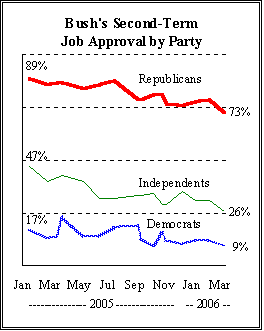 The survey finds that the falloff in
the president's support since the start of his second term includes a
significant decline in support among Republicans. Overall, half of Americans
approved of Bush's overall job performance in January 2005, while 43%
disapproved. Today, just 33% approve compared with 57% who disapprove.
The survey finds that the falloff in
the president's support since the start of his second term includes a
significant decline in support among Republicans. Overall, half of Americans
approved of Bush's overall job performance in January 2005, while 43%
disapproved. Today, just 33% approve compared with 57% who disapprove.
In January 2005, Bush earned a lofty 89% approval from members of his own
party, but that has declined to 73% in the current survey. Among independents,
the number approving of Bush's job performance has fallen from 47% in January
2005 to 26% today; and Bush's support among Democrats, already quite low, has
fallen by about half since the start of his second term (from 17% to 9%).
Core Supporters Less Satisfied with Bush
A more detailed portrait of the falloff in Bush approval shows significant declines among groups who had been the president's strongest supporters. In January 2005, conservative Republicans approved of the president by a margin of 94% to 3%. While still overwhelmingly supportive, today just 78% of conservative Republicans approve while 16% disapprove. Support from moderate and liberal Republicans has dropped by about the same amount, from 82% to 65% today.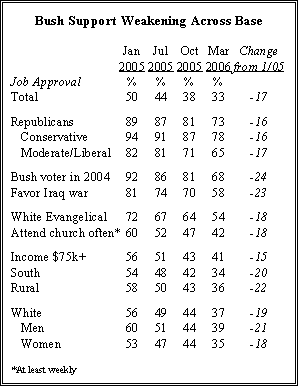 Many people who voted for Bush in the
2004 election are more critical of his performance. Currently, 68% of Bush
voters approve of his performance, while 22% disapprove. Shortly after the
election Bush voters approved of his performance by a margin of 92% to
4%.
Many people who voted for Bush in the
2004 election are more critical of his performance. Currently, 68% of Bush
voters approve of his performance, while 22% disapprove. Shortly after the
election Bush voters approved of his performance by a margin of 92% to
4%.White evangelical Christians were solidly behind the president throughout his first term in office, but that support has waned over the past 15 months. Currently, just 54% of white evangelicals approve of the president's job in office, while 36% disapprove. Bush's support has also dropped among people who attend church each week or more frequently. According to post-election exit polls conducted by the National Election Pool, these voters backed Bush over Kerry by a 61%-38% margin. But today more disapprove (46%) than approve (42%) of his performance.
Even among people who say that the war in Iraq was the right decision, support for the president has declined. Today, 30% of people who believe that the use of force in Iraq was the right decision disapprove of the president's overall job performance, up from just 14% in January 2005. Job approval among Iraq war supporters has fallen from 81% to 58% over this time span.
Congress Credited for Ports Stance...
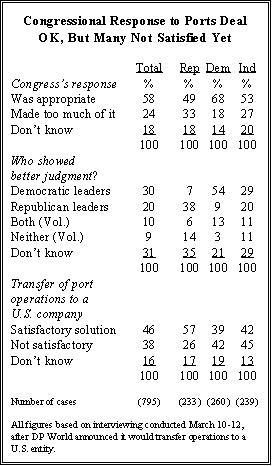 Congress has drawn bipartisan praise
from the American public for its response to the possible transfer of U.S. port
operations to a United Arab Emirates company. Nearly two-thirds of Democrats
(68%), and roughly half each of independents (53%) and Republicans (49%) said
Congress acted appropriately, though a third of Republicans felt too much was
made of the issue.
Congress has drawn bipartisan praise
from the American public for its response to the possible transfer of U.S. port
operations to a United Arab Emirates company. Nearly two-thirds of Democrats
(68%), and roughly half each of independents (53%) and Republicans (49%) said
Congress acted appropriately, though a third of Republicans felt too much was
made of the issue.Democratic leaders fared somewhat better than Republicans in this debate, based mostly on the support of their own partisans. Overall, three-in-ten say they thought Democratic leaders showed better judgment on this issue, while 20% favored the Republican leaders. Only 38% of Republicans favored the way GOP leaders handled the issue, compared with 54% of Democrats who favored the job their leaders did. Independents were more divided (29% favored how Democratic leaders handled the issue, 20% Republicans), while half saw no difference between the parties' performance.
...But No Boost in Approval
While members of Congress may have averted widespread criticism in this case, there is no evidence that their stand against the Dubai ports deal improved either party's public image. Comparable percentages say they approve of the job Republican leaders (32%) and Democratic leaders (34%) are doing both figures are unchanged from January and have not moved significantly in more than six months.While DP World, the United Arab Emirates company involved in the deal, agreed on March 9 to transfer all operations at U.S. ports to an American entity, 38% of Americans do not think that this is a satisfactory solution to the issue, and another 16% aren't sure how they feel about it. This dissatisfaction is strongest among the three-quarters of Americans who opposed the deal originally, 44% of whom are not satisfied with the current solution, while 45% are satisfied. Among the minority who approved of the original deal, most see this as a satisfactory solution by a 66%-27% margin.
Will This Hurt America's Standing?
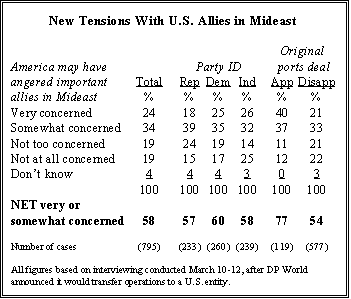 Despite public support for scuttling
the ports deal, most Americans are either very (24%) or somewhat (34%)
concerned that America may have angered important allies in the Middle East by
opposing this deal. This concern crosses party lines, with Democrats,
Republicans and independents expressing comparable levels of concern.
Despite public support for scuttling
the ports deal, most Americans are either very (24%) or somewhat (34%)
concerned that America may have angered important allies in the Middle East by
opposing this deal. This concern crosses party lines, with Democrats,
Republicans and independents expressing comparable levels of concern.This consideration was clearly a factor for the minority of Americans who supported allowing the original deal to go through. Though only 14% took this position, they are twice as likely as the majority who opposed the deal to be very concerned about how this will affect U.S. interests in the Middle East, and 77% are at least somewhat concerned in this regard.
Foreign Ownership vs. Foreign Investment
While Americans tend to think that it is bad for America when investors from other countries own companies here, they tend to take a favorable view of foreign investments in the United States. Overall, more see foreign ownership as bad for the country by a 53% to 33% margin, while more see foreign investments in the U.S. as good for the country by a comparable 53% to 36% margin.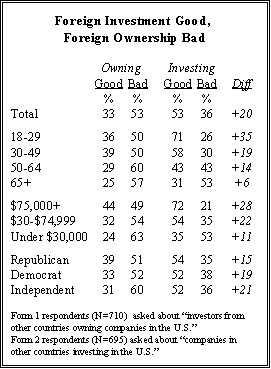 Younger Americans and those in
higher-income households tend to be more supportive of both foreign ownership
and investment, but age and income gaps are the greatest with respect to views
of investment. People under age 30 see investment in the U.S. as good by a 71%
to 26% margin, but half believe foreign ownership has a negative impact. By
comparison, majorities of those ages 65 and older tend to see both foreign
ownership (57%) and foreign investment (53%) as bad for the U.S.
Younger Americans and those in
higher-income households tend to be more supportive of both foreign ownership
and investment, but age and income gaps are the greatest with respect to views
of investment. People under age 30 see investment in the U.S. as good by a 71%
to 26% margin, but half believe foreign ownership has a negative impact. By
comparison, majorities of those ages 65 and older tend to see both foreign
ownership (57%) and foreign investment (53%) as bad for the U.S.Americans in households earning $75,000 or more annually are the most supportive of foreign ownership and investment 72% say the latter is good for the country. But Americans in low-earning households tend to say both are bad for the country.
By comparison, there is almost no partisan divide on issues of foreign ownership and investment. A slim majority of both Republicans and Democrats see ownership as bad for the country, while a slim majority of both say that investment is good.
Democratic Advantage on Foreign Investment
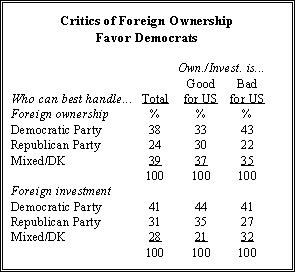 While Republicans and Democrats around
the country hold similar views on the costs and benefits of foreign ownership
and investment, the public rates the Democratic Party as stronger on the issue,
particularly among those who see these as bad for the country. Among the 53% of
Americans who say it is bad for the U.S. when investors from other countries
own companies here, more favor the Democrats to handle this issue than
Republicans by two-to-one (43% to 22%). The Democrats are also viewed as better
able to address foreign investment in the United States.
While Republicans and Democrats around
the country hold similar views on the costs and benefits of foreign ownership
and investment, the public rates the Democratic Party as stronger on the issue,
particularly among those who see these as bad for the country. Among the 53% of
Americans who say it is bad for the U.S. when investors from other countries
own companies here, more favor the Democrats to handle this issue than
Republicans by two-to-one (43% to 22%). The Democrats are also viewed as better
able to address foreign investment in the United States.Bush: Personal Impressions
The public's personal impressions of Bush's trustworthiness, effectiveness and leadership have all declined sharply since last fall. In this regard, a significantly higher percentage of Americans believe that Bush is "out of touch" with what is going on with the government than said that about former President Reagan during his second term, in August 1987.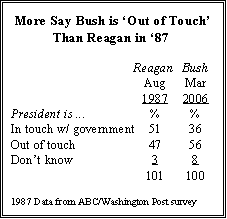 Fully 56% say that about Bush now,
compared with 47% who expressed that view of Reagan nearly 20 years ago. At
that time, Reagan's image had been tarnished by the Iran-contra affair, though
his approval rating was much higher than Bush's is currently (50% in September
1987 vs. 33% today).
Fully 56% say that about Bush now,
compared with 47% who expressed that view of Reagan nearly 20 years ago. At
that time, Reagan's image had been tarnished by the Iran-contra affair, though
his approval rating was much higher than Bush's is currently (50% in September
1987 vs. 33% today).In a Word...Incompetent
President Bush's declining image also is reflected in the single-word descriptions people use to describe their impression of the president. Three years ago, positive one-word descriptions of Bush far outnumbered negative ones. Over the past two years, the positive-negative balance has been roughly equal. But the one-word characterizations have turned decidedly negative since last July.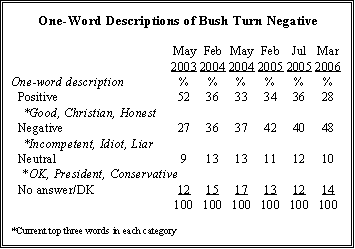 Currently, 48% use a negative word to
describe Bush compared with just 28% who use a positive term, and 10% who use
neutral language.
Currently, 48% use a negative word to
describe Bush compared with just 28% who use a positive term, and 10% who use
neutral language.The changing impressions of the president can best be viewed by tracking over time how often words come up in these top-of-the-mind associations. Until now, the most frequently offered word to describe the president was "honest," but this comes up far less often today than in the past. Other positive traits such as "integrity" are also cited less, and virtually no respondent used superlatives such as "excellent" or "great" terms that came up fairly often in previous surveys.
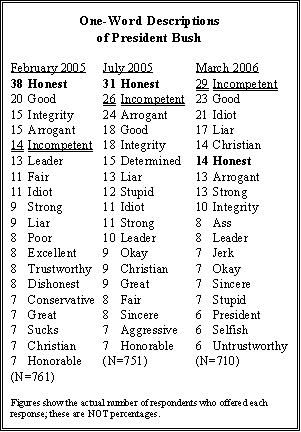 The single word most frequently
associated with George W. Bush today is "incompetent,"and close behind are two
other increasingly mentioned descriptors: "idiot" and "liar." All three are
mentioned far more often today than a year ago.
The single word most frequently
associated with George W. Bush today is "incompetent,"and close behind are two
other increasingly mentioned descriptors: "idiot" and "liar." All three are
mentioned far more often today than a year ago.Fewer See Bush as Conservative
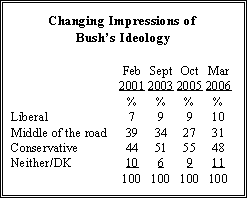
Public perceptions of the president's ideological leanings have shifted throughout his presidency. Currently, a 48% plurality view Bush as conservative, down from 55% last October. This marks the first time since shortly after Bush took office in 2001 that fewer than half have described him as conservative.Just 45% of self-described conservatives now view Bush as a conservative, down from 59% in October. The change in views of Bush's ideology has been less pronounced among moderates and liberals. Liberals continue to overwhelmingly describe Bush as a conservative 65% express that view now, about the same as in October (68%).
 Similarly, fewer Americans now say that
Bush listens to conservative members of his party, rather than moderates, when
it comes to national policy. Currently, a narrow majority (51%) says Bush
listens mostly to conservative Republicans, down from 57% last October. Just
39% of self-described conservatives now say that Bush listens more to
conservative members of the GOP; in October, 51% of conservatives said Bush
mostly listened to conservative members of the Republican Party.
Similarly, fewer Americans now say that
Bush listens to conservative members of his party, rather than moderates, when
it comes to national policy. Currently, a narrow majority (51%) says Bush
listens mostly to conservative Republicans, down from 57% last October. Just
39% of self-described conservatives now say that Bush listens more to
conservative members of the GOP; in October, 51% of conservatives said Bush
mostly listened to conservative members of the Republican Party.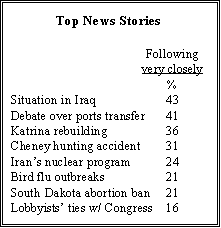 Ports Debate Draws Broad
Attention
Ports Debate Draws Broad
Attention
News about the situation in Iraq continues to top the public's news interest.
Since the war began nearly three years ago, only a handful of major stories
such as Hurricanes Katrina and Rita last year have drawn greater
public interest than the war.But this month, nearly as many Americans said they tracked news of the Dubai ports deal very closely as followed war news very closely (41% vs. 43%). This issue also ranks fairly high in news interest among leading political stories over the past two decades. And roughly four times as many Americans paid very close attention to the debate over the ports transfer than closely tracked the proposed sale of the oil company Unocal to a Chinese company last July (11% very closely).
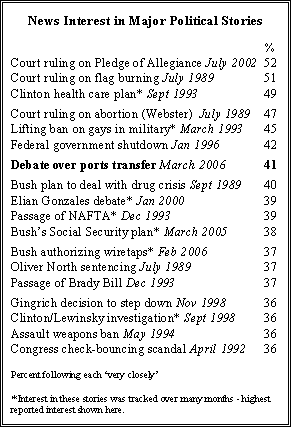 Reports on rebuilding efforts in areas
affected by Hurricane Katrina also continue to attract considerable attention;
36% followed this news very closely, about the same as in December (39%).
Roughly three-in-ten (31%) say they very closely followed news that Vice
President Cheney accidentally shot and wounded a fellow hunter. The incident
occurred Feb. 11, approximately a month before the field period for this
survey.
Reports on rebuilding efforts in areas
affected by Hurricane Katrina also continue to attract considerable attention;
36% followed this news very closely, about the same as in December (39%).
Roughly three-in-ten (31%) say they very closely followed news that Vice
President Cheney accidentally shot and wounded a fellow hunter. The incident
occurred Feb. 11, approximately a month before the field period for this
survey.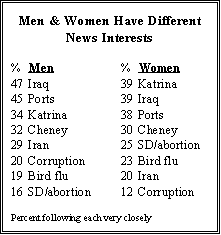 Other news stories have drawn far less
public interest: 24% very closely followed news on Iran's nuclear program; 21%
each paid very close attention to news on bird flu outbreaks and the South
Dakota law banning most abortions; and 16% say they tracked news of lobbyists'
financial ties with members of Congress very closely.
Other news stories have drawn far less
public interest: 24% very closely followed news on Iran's nuclear program; 21%
each paid very close attention to news on bird flu outbreaks and the South
Dakota law banning most abortions; and 16% say they tracked news of lobbyists'
financial ties with members of Congress very closely.There is a gender gap in interest toward several of the month's news stories. More men than women followed the ports debate and Iraq war news very closely; more women than men closely tracked news on the South Dakota abortion law, and paid somewhat more attention to hurricane rebuilding and bird flu.
Commentary: